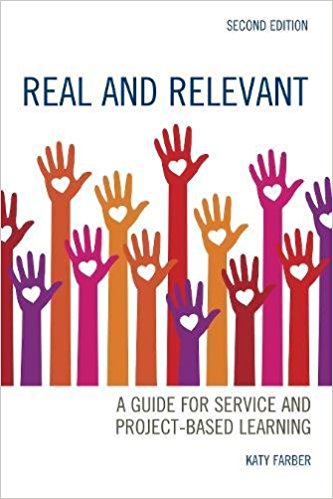
 Things are moving fast on the new edition of Real and Relevant: a guide for service and project based learning. This is an update to Change the World with Service Learning: How to organize, lead and assess service learning projects, published in 2011. The new edition will be released on June 30th, 2017 and is now available for pre-order in both hardback and paperback (or even better, ask for it at your local bookstore).
What’s new in this edition?
- New chapters (on project based learning; my research on middle level service learning; Genius Hours and Makerspaces; and technology tools to support service and project-based learning.)
- New foreword by the amazing Penny Bishop, researcher, author, professor, and Associate Dean of the School of College of Education and Social Services at the University of Vermont.
- Updated and expanded resources (both at the end of each chapter and in the references).
- New interviews with teachers and examples from the field throughout.
Here’s what two professors had to say about the new edition:
“With an intimate portrayal of her service learning experience, elementary teacher and teacher educator Katy Farber provides a hands–on guide for other teachers to take the plunge into service/project based learning. Her extensive practice and research allows for an up-to-date understanding of service/project based learning, so that teachers can engage students from grades 3-12 at the classroom, school and community level. As a teacher educator, I find this guide invaluable for introducing service/project based learning to my pre-service and practicing teachers.”
–James Nagle, Associate Professor, Saint Michael’s College; Co-Director, Middle Grades Collaborative
“This book is a tremendous resource for the 21st century progressive teacher. Offering a powerful balance of practical guidance and research-based examples, this new edition provides a comprehensive toolkit for service learning in the 21st century. The addition of new chapters devoted to technology, Makerspaces, and Genius Hours provides a compelling and timely illustration of the authentic ways in which service learning can work in conjunction with other contemporary movements in education.”
–Jessica DeMink-Carthew, Assistant Professor, Department of Education, Middle Level & Elementary Teacher Education, University of Vermont)
And how about the new cover? I hope it reflects the kind of deep student engagement and heart centered work I would love to inspire with this book.
I’ll be posting about giveaway opportunities shortly for June 30th, so please stay tuned. And if you are a professor or blogger interested in reviewing a copy of this book please contact me or Rowman Littlefield Publishers.