Are you a “Learning Maximizer”?

How do you maximize student learning? What are the ways we can do this, and how might our roles and labels get in the way of helping all students?

Words matter. Job titles, given labels, justly or not, can affect how we feel about ourselves and our jobs. They can affect our we are perceived by our students, and how our students perceive themselves.

Meet Erika (aka Learning Maximizer)

Erika Saunders, of the Science Leadership Academy Middle School (SLA-MS) in Philadelphia, knows this. She’s a founding teacher at SLAMS, which is in its second year. She renamed her special educator position as a Learning Maximizer, and heads that department.

She even has this title on her classroom door, and well, also has her own Learning Maximizer official uniform. I’m pretty certain that Erika can save the world.


Erika Saunders, Learning Maximizer

The official Learning Maximizer uniform!

Meet Science Leadership Academy Middle School

SLA-MS is a project based learning focused middle school in its second year. Currently, it hosts fifth and sixth grade students, and will bring on a new grade each year, up until eighth grade.

Learning Maximizers

The Core values of the school are:

  • Inquiry
  • Research
  • Presentation
  • Reflection
  • Collaboration

This is rooted in relevant project-based work with community partners. Students sign up for mini-courses, often working with parents, community organizations, both on campus, and in the surrounding neighborhood.

SLA-MS learning maximizers.

Group work in progress at SLA-MS.

At SLA-MS, they “unprivilege grades” and “privilege” community-based, relevant projects. All students DO. They collaborate, create on the computer, and work side-by-side with teachers.

All students are “OUR” students

Okay, back to the resident Learning Maximizer at SLA-MS.

According to Erika, every student at SLA-MS should have a Learning Maximizer. Erika shared her mindset for being a Learning Maximizer at SLA-MS, and it seemed especially powerful and inspiring.

Erika doesn’t view a certain set of students with learning disabilities as “her” students. All students at SLAMS are “her” students. She said:

“There are simply kids that have official paperwork, and students who don’t.”

When working with students, she teaches them learning strategies, and describes their reading, for example, at different levels, not “low.” These words matter. Just like her title. She asks students:

“What are you not good at yet?”

“You know how to do so many things. Let’s start with that, and figure out what don’t you know yet.”

Then she works with students to help them maximize their learning, by learning about themselves, their strengths and challenges, and how to work with those challenges.

Erika collaborates with teachers, meets with teams, and works toward being proactive instead of reactive in planning, teaching, and supporting students. Project-based learning provides her with many opportunities to promote relevance, engagement, and self-direction as she guides her students.

Philosophies at work

In her role as learning maximizer, we can see a combination of educational philosophies at work:

  • Growth Mindset: Erika believes that all students have the ability to understand how they learn, and they can work together to make a plan to learn at optimal levels in a way that works for each students. How can we carry this message into our work? How can all teachers think about each student’s needs, backgrounds, and experiences and help them plan for their educations with growth mindset?
  • Knowing students deeply: In order to help students learn at high levels, teachers need to know students well and have a trusting, strong relationship with them.

Street-level view of students

One way to know students deeply is to gather information about them in a way an ethnographic researcher would, according to this post in Edutopia. We can gather data about students at different levels to help us connect to students and to plan the best strengths based education plans as possible.

Just how do we do this? By asking questions such as these:

  • Tell me one way you’re feeling successful in my class.
  • Tell me one area in which you’re struggling.
  • How do you learn best?
  • What feedback do you have for me?
  • How could I support you to feel successful?

Do these questions sound familiar? This is just the approach Erika is taking in how she speaks with students about their learning.


Culturally responsive learning environments maximize student learning. This can come about through student interviews and focus groups, and by tracking class participation and academic language.

These learnings can become part of a student’s learning profile, and can be featured and reflected upon in students’ personalized learning plans. That way, students have a place to regularly reflect on their own learning, their growth, and their goals for the future.

What’s your tagline?

In her work to maximize learning, Erika is trying to level the playing field, and create a culturally responsive learning environment rooted in strengths and growth mindset.

Erika shared her tagline that she shares with adults, that guides her work and focus:

“Righting the things that were once wrong.”

Erika inspires me. Special educators and education is often left out, or not deliberately included in, discussions, professional development, plans and reading about personalization. But most of the time, these are the very people that have experience personalizing for students, crafting activities, lessons and assessments to meet individual needs.

Personalization and true student engagement is rooted in knowing our students well, and helping them understand how they best learn. Special educators are key partners in this journey, and can help lead the way.

What would happen if we thought of special educators (or learning maximizers) as personalization specialists, and resources for all students and teachers?

What if every single teacher (and person who works in schools) thought of all students as “their” students, and helped to create a learning environment where all students are known and we are all learning maximizers?

How can you be a learning maximizer?

SaveSave

Salamander Sky is coming!

It seems virtually impossible. As I sit here during the bomb cyclone winter storm (how have I never heard this expression before?), awaiting -45 degree wind chills expected this weekend, salamanders seem far, far away.

And yet. The snow will melt. The earth will soften under cool spring rain, and the delightful spotted salamanders will make their slow and steady journey to pools and ponds by our house.

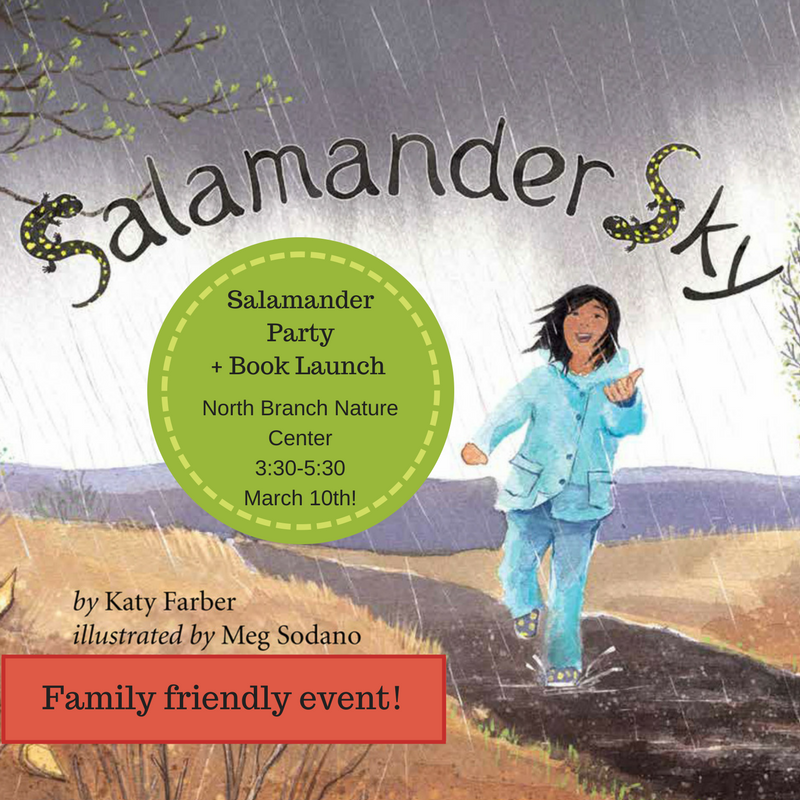
Luckily, this salamander crossing season is different. It coincides with the publication of my new picture book, Salamander Sky, releasing to the world on March 2, 2018 with Green Writer’s Press. The fabulous illustrator is Meg Sodano, and I can’t wait for readers to see her incredible paintings of April, salamanders, and the night sky.

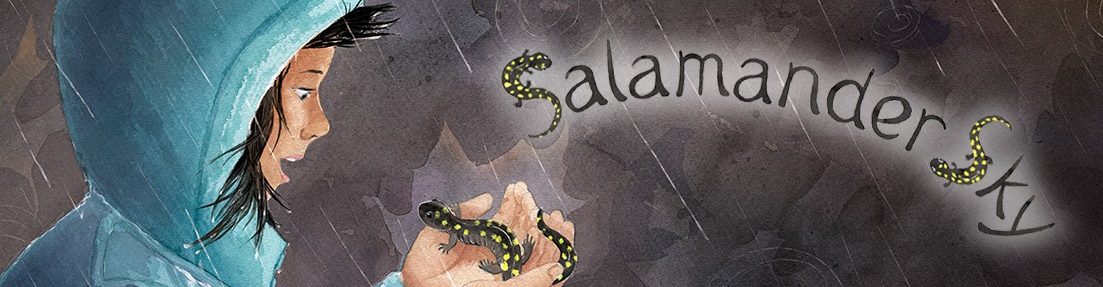
Salamander Sky is the story of 10 year old April, who waits impatiently for the night that her mom will take her out to help the salamanders cross the dirt road by her house.  She wants to help these vulnerable creatures, who only come out on a few nights, and lumber along our roads. Come along with them, and learn how you can help salamanders in  your area survive this crossing, and feel good in the process.

Salamander Sky is available for pre-order at your local bookstore (best choice!) or on Amazon or Barnes and Noble.

We are hosting a book launch and salamander crossing party at the North Branch Nature Center in Montpelier, Vermont on March 10th from 3-5:30, and we will have presentations from naturalist Sean Beckett and Elizabeth Morse from the Center for EcoStudies about salamander migration, vernal pools, and citizen science (AND Salamander cookies!) as well as copies of the new book for sale.

Other upcoming events include:

  • Bridgeside Books Reading: March 17th, 10:30am, Waterbury
  • Kellogg Hubbard Library, March 24th, 10:30am, Montpelier
  • Educator event, Bear Pond Books, TBD

Are you a librarian, book seller, parent, or teacher? Here is some information about what Salamander Sky has to offer:

  • targets many of the Next Generation Science Standards for elementary school students, including life cycles, wetland habitats, diversity, adaptations and human impact
  • communicates a strong conservation message
  • geared toward preschool through elementary school aged students
  • models first hand exploration and investigation in nature
  • addresses human impact on the environment and encourages active participation in solutions
  • provides a resource for science teachers, environmental educators and parents to introduce inquiry to students
  • inspires engagement and curiosity
  • focuses on a vulnerable and often unnoticed species of amphibians that inhabits much of the Eastern United States
  • embraces diversity and promotes women in science

Please be in touch if you would like to schedule a reading, a workshop about citizen science, or a writing workshop with your organization, class, or group!

Back to high winds, freezing temperatures, and the bomb cyclone. I’m waiting for the salamander sky (feels like years away!).

Introducing “Cabot Leads”

Use service learning to grow your community

a model for service learning

What do you do when you’re a 5th-through-8th middle school housed in two separate buildings?

If your 7th-and-8th graders are with the high school, and 5th and 6th graders are off on their own, how can you provide an opportunity all middle graders to feel involved in the middle school? How do you promote leadership and engagement, and connect students to their communities?

For the Cabot School, service learning is the answer.

Continue reading