Sunday Reading (antibiotics in eggs, BPA and obesity, fired for breastfeeding)

(First posted at Non-Toxic Kids)

I hope you’ve all had a lovely weekend.  What are you reading?  In addition to the second Hunger Games book, borrowed from a student, these articles are what I am reading tonight.

New research strengthens the link between BPA, obesity, and Type 2 diabetics, according to this article at Huffington Post.“When you eat something with BPA, it’s like telling your organs that you are eating more than you are really eating,” says Angel Nadal, a BPA expert at the Miguel Hernandez University in Spain.

The result is a spike in insulin, which can lead to weight gain and diabetes, according to research published last week in PLoS ONE.
Noteworthy parts of the article point to how BPA is showing negative health outcomes even at low levels, much like lead. Indeed this article and research explains how this chemical is most concerning for pregnant women and developing fetuses.  The article says:

“The fetus is not only exposed to BPA but also to higher levels of insulin from the mother, making the environment for the fetus even more disruptive,” says Nadal. “This is a very delicate period.”

Predictably, the American Chemical Council continues its stance that the chemicals is harmless, despite mounting scientific evidence to the contrary.  When will Americans say enough is enough and protect people from this hormone altering chemical for good?
And in the another reason to buy only locally, humanely raised and organic meats (or going vegetarian) file, is this article also at the Huffington Post.  It details the half measures of new FDA rules regarding antibiotics used in livestock, and the power of Big Ag.
While banning the practice of injecting eggs with antibiotics (did you know they that that??  I didn’t!), the FDA stopped short of meaningful regulations on the use of antibiotics in livestock farming.  According to the article:

“More than 70 percent of antibiotics go to livestock, not people, says the bill, and they are used on more than 83 percent of grower-finisher swine farms, cattle feedlots, and sheep farms and found in 48 percent of U.S. streams.”

I wrote here about the promise of regulations of a certain kind of antibiotics, but it looks like that has been watered down even more.  Big pharmaceutical companies deny any connection between the use of antibiotics in factory farming and the growth of antibiotic resistance in humans even while the Centers for Disease Control and Prevention reports that hospital-associated infections, which are likely to be antibiotic resistant, cause or contribute to 99,000 deaths each year.

This is a confusing topic but also illustrates the growing power of corporations over public health when the almighty dollar is involved.  When will people realize that our health is priceless, and that corporations, no matter how much we want them too, can’t regulate themselves?

And lastly, an article about the firing of Donnicia Venters because she discussed wanting to express milk at work so she could continue breast feeding her baby.  This article shares the stunning comment of the judge who decided there was no discrimination involved in this case because:

“The law does not punish lactation discrimination,” U.S. District Judge Lynn Hughes, who is male, ruled in a three-page order. Dismissal because of pregnancy, childbirth or a related medical condition is illegal, Hughes noted, but “lactation is not pregnancy, childbirth or a related medical condition.”

First of all, how is it possible that in 2012, the law does not punish lactation discrimination?  With doctors and medical professionals the world over showcasing the health benefits of breastfeeding, and the skyrocketing rates of obesity and other conditions breastfeeding is shown to decrease?  I know our society has come a long way, but this reminds me how much farther we have to go. When a women is not even protected in her job from firing based on her choice to continue breastfeeding her baby, we as a society should be ashamed.
Secondly, how is lacatation not a childbirth related medical condition?  I’d have to agree with Venter’s lawyer on this one:

“Under the law that prohibits discrimination on pregnancy, childbirth or related medical condition, lactation is a related medical condition to pregnancy and childbirth,” argued Timothy Bowne, an Equal Employment Opportunity Commission attorney. “There are no people that we know of who lactate who haven’t given birth recently.”

We need national legislation protecting all women from being fired for wanting to express breast milk at work, and clearly, a new definition of lacatation if that is what it will take.  That’s why I am supporting the Breastfeeding Promotion Act which will:

*Amends the Civil Rights Act of 1964 to protect breastfeeding women from being fired or discriminated against in the workplace.

*Protects breastfeeding mothers by ensuring that executive, administrative, and professional employees, including elementary and secondary school teachers (in addition to non-exempt employees covered by the previous amendment), have break time and a private place to pump in the workplace.
Join me and send a message to Congress with Momsrising. What’s your take on any of these stories?

New Mercury and Air Toxics Rule Released Today (breathe deep, American families)

(first posted at Non-Toxic Kids)

Can you hear it?  If you listen very, very closely, you might hear a huge sigh of relief from parents everywhere, across America.

Parents of children with asthma.  They will likely have to take fewer trips to the emergency room.

Pregnant mothers, trying to make the right choices to limit their exposures to harmful mercury and other toxins.

Parents of all children, everywhere, who think about the power plant in the next town, or the next state.  Parents worrying about the air where they work, or nearby where their children go to school, and the exposures their family faces everyday from just living.

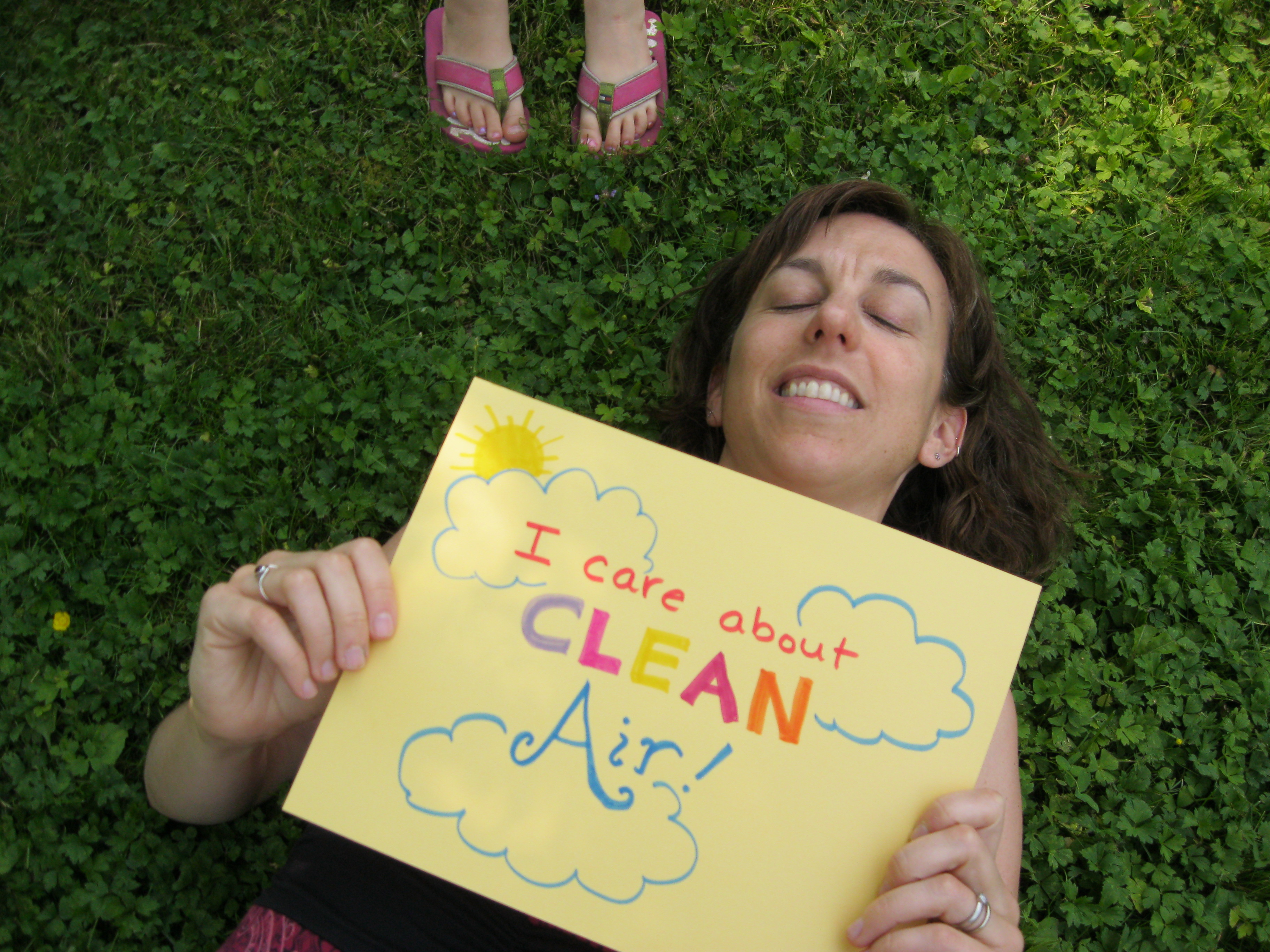
Today was a monumental day in the fight for clean air. According to the EPA:

“The U.S. Environmental Protection Agency (EPA) has issued the Mercury and Air Toxics Standards, the first national standards to protect American families from power plant emissions of mercury and toxic air pollution like arsenic, acid gas, nickel, selenium, and cyanide. The standards will slash emissions of these dangerous pollutants by relying on widely available, proven pollution controls that are already in use at more than half of the nation’s coal-fired power plants.

EPA estimates that the new safeguards will prevent as many as 11,000 premature deaths and 4,700 heart attacks a year. The standards will also help America’s children grow up healthier – preventing 130,000 cases of childhood asthma symptoms and about 6,300 fewer cases of acute bronchitis among children each year.”

Can you hear the sigh of relief now? I know that I am deeply thankful that this long awaited rule will have such positive health outcomes for our nation’s children, for our economy, and for our collective future.  Tonight I am thankful for each and every person who worked on this issue:  President Obama, Lisa Jackson, the EPA, but also every member of the Moms Clean Air Force, and the deep and wide coalition of environmental, public healthbusiness, religious and medical groups who supported this important new rule.

Luckily, due to an early release day at school, I had the chance to watch the press conference live.  I learned that Lisa Jackson herself has two sons who struggle with asthma.  She shared how she spent a Christmas, 15 years ago, in the hospital with her son after an asthma attack.  There are real people behind these statistics whose lives are dramatically altered by preventable air pollution.

We know the devastating effects of these toxins on developing bodies, but let’s review it.  According to the Environmental Defense Fund:

“Mercury exposure can cause brain damage in infants, and can affect children’s ability to walk, talk, read and learn. Experts estimate that hundreds of thousands of babies are born each year with potentially unsafe levels of mercury in their blood.

Many of the other toxic pollutants also controlled by the new rules — such as chromium, arsenic, dioxin and acid gases — are known or probable carcinogens and can attack the brain, lungs, liver, and kidneys.”

The Mercury and Air Toxics Rule is a giant leap toward protecting America’s families from pollution and toxins in our air. I couldn’t think of a better holiday present.  Tonight, I am thankful and hopeful.  What about you?

Growing up Blue and White in Happy Valley

It’s hard to understand how profound the Penn State child abuse scandal is unless you live or lived in State College.

Unless you grew up in a town where on Saturdays every living soul was either heading to the game, was already at a tailgate, or was already in their seat in bleachers of Beaver stadium.

Unless every Saturday your family spent together—either meeting  up with family friends at a tailgate, eating cheesy, saucy foods in sweaters and Penn State sweatshirts, tossing  footballs, goofing around, and looking for players.  Checking in about lives, laughing, and talking about how Penn State could win.

Unless you sat in the stands, layered up against the sub zero cold, cheek to cheek with your brother and parents, screaming and yelling and cheering, hair covered with flecks of snow.

Unless you watched the exuberance of the sport, for years, and the community building effect it had on students, children and adults alike.  Collective, soul rousing cheers–raising your voice with thousands of people.  White outs.  The Nittany lion’s endless antics. The shirtless, painted, screaming fans.  The thumping band, echoing in your chest.  Eating stadium food in all of its salty, unhealthy glory.

Unless one of the first songs you learned as a toddler was Fight on State, and the song is as familiar as Mary had a little lamb.

Unless you grew up beside Joe Paterno’s and Jerry Sandusky’ children.  Knew them, went to classes with them, knew Joe’s house, even partied in Sunset park behind it, and kissed a boy in his backyard.

Unless you spent away games dressed in your Penn State clothes, eating tailgate food in your house, gathered around  the TV.  Mom cheering at the screen, my dad ironing, looking up, eager to find for the score.  The landscape of your weekend, the planets in your family constellation.

You really can’t imagine.

The trouble with pedestals is that it is a long fall down.  And a community, a university, and a family falls along.

One of the intricacies of youth is the ability to idolize, and place upon a pedestals, our parents, our leaders, our heroes.  It is dangerous, reckless, and damaging when we see them fall—when we learn that people aren’t perfect, that indeed people we believe in so much, and have watched for so long, can fail.

It takes your breath away, and leaves you wondering about your own  life, your own potential failings, and the indelible and oppressive vulnerability that haunts us all.

I’ve seen this in my life—I  know the familiar let down, the hollowness and the sense of becoming  unmoored.  Growing up, I saw it my one of my coaches, and in my own family. I carry these disappointments deep in my adult self, under layers.

But it doesn’t make it hurt less now.

It only reminds me how fragile this life is and how easily things are taken away– how every single decision we make can change our lives forever.

And none of it really matters, even how my own childhood, the fabric of my upbringing, was centered around this mythic sport and coach.  What matters are the relationships, not the vehicles, necessarily, or the traditions that surrounded them.

Because in this instance, what matters most is that children were hurt.  They were abused, horribly and irrevocably hurt and victimized and no one stopped it.  Not even the one who saw it, or our beloved Joepa.

That is our biggest tragedy.

And no matter who is fired, or how many students turn over cars, or who might pine for the simple glory days of a Penn State youth, it doesn’t change this.

We mourn for the children first, for what they lost.  We hope in our hearts for their recovery, for healing, for justice.

Second, our childhood, and our family traditions, have been altered forever, but what remains is what always mattered most.  Love of community, family, friends, and sport.

This will rise again in Happy Valley.  But yes, we have lost our innocence, and another hero.

image:  by acaben on Flickr under CC